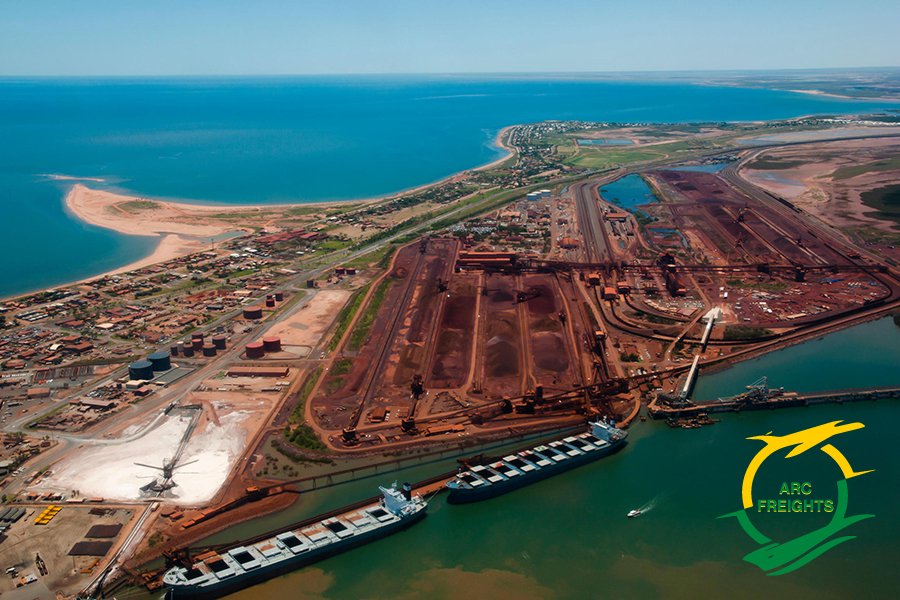
The dual engine failure of the MV Zorbas in December 2025 shocked the logistics industry. The bulk carrier lost power twice while navigating Australia’s most critical export artery. While this incident involved iron ore, it serves as a macro-level stress test for every Australian exporter. This article seeks to analyse the incident’s impact on national supply chains. It also outlines essential strategies for Australian businesses moving goods to ASEAN and beyond.
Background
The first failure occurred shortly after leaving the Hancock Prospecting berths. Multiple tugs had to tow the vessel to a “refuge zone” to prevent blocking the narrow shipping channel and delaying other traffic.
Authorities cleared the ship to sail, but the engine failed again. Tugs deployed again and moved the vessel to safe anchorage. Fortunately, the vessel did not run aground. Consequently, the channel remained open with minimal operational disruption.
Impact
This near-miss follows a similar February 2025 emergency involving the FMG Nicola. Together, they highlight the danger of a “Single Point of Failure” in our supply chains.
Port Hedland is not merely a bulk shipping hub; it is the heartbeat of our national economic throughput. The port handled 48.5 million tonnes of throughput in November 2025 alone. Experts estimate a “hard” grounding would take six months to clear. A blockage here stops the cash flow that fuels the Australian economy.
For exporters, this highlights a critical vulnerability. Channel closures impact all maritime scheduling, not just iron ore. When a major artery clogs, vessel availability tightens nationwide. Delays in the Pilbara can ripple outward, causing rolled cargo in Melbourne and Sydney.
Foreign buyers in Indonesia or Philippines etc. do not care about local logistical failures or channel blockages. They care only about contract fulfillment and the timely arrival of their goods. A closed port equals a breached contract and a damaged national reputation.
Logistics Measures
Cargo Insurance
Many businesses export on terms where they assume risk ends once cargo is loaded. Smaller ones often skip insurance to save money. Unfortunately, this assumption is dangerously flawed. Under the Hague-Visby Rules, carriers are exempt from liability for “latent defects”. This includes cases like engine failure or errors in the “management of the ship.”
Exporters also face the risk of General Average during these incidents. This maritime principle dictates that all cargo owners share the cost of a salvage operation. Had the Zorbas run aground, you would receive a bill for the rescue, even if your cargo remains untouched.
- Financial Exposure
- You pay for the ship’s rescue based on your cargo’s value.
- Asset Protection
Human Intervention
Digital platforms excel at data visibility and repetitive tasks. However, even the best software has its limitations. Automated tracking platforms, for example, can report the vessel delay. But they cannot resolve the issue. An app cannot verbally pressure a stevedore to prioritize your perishable exports over others. Pilots and tug masters saved the channel that Friday, not algorithms.
Relying on digital-only freight booking platforms leaves exporters vulnerable during physical crises. Effective export logistics requires human intervention. This provides two distinct advantages over digital-only platforms:
- Immediate Rerouting
- Professional freight forwarders divert cargo to alternative exit points. This could be railing goods to Melbourne or transshipping via Singapore.
- Direct Communication
- Freight forwarders like ArcFreights use WhatsApp to give you raw, unfiltered updates. This bypasses the silence of automated status systems.
Further Reading: What Is Freight Forwarding?
Conclusion
The MV Zorbas near-miss stands as a definitive warning shot for 2026. Infrastructure vulnerabilities persist even as export volumes hit record highs. Consequently, Australian exporters must stop viewing logistics as a mere commodity. Securing cargo insurance and human oversight maintains reliability. This is the only currency that matters to your ASEAN buyers.
Arc Freights is Australia’s leading Freight Forwarder offering QUALITY & RELIABLE logistics services in more than 140 countries. Having plied our expertise in ASEAN for nearly two decades, we are the trusted partner for logistics between Australia and Brunei, Cambodia, Indonesia, Laos, Malaysia, Myanmar, Philippines, Singapore, Thailand, and Vietnam. With expert knowledge, advanced technology, and a commitment to reliability, we provide seamless logistics management, including door-to-door sea freight services, that helps you focus on what matters most—growing your business.