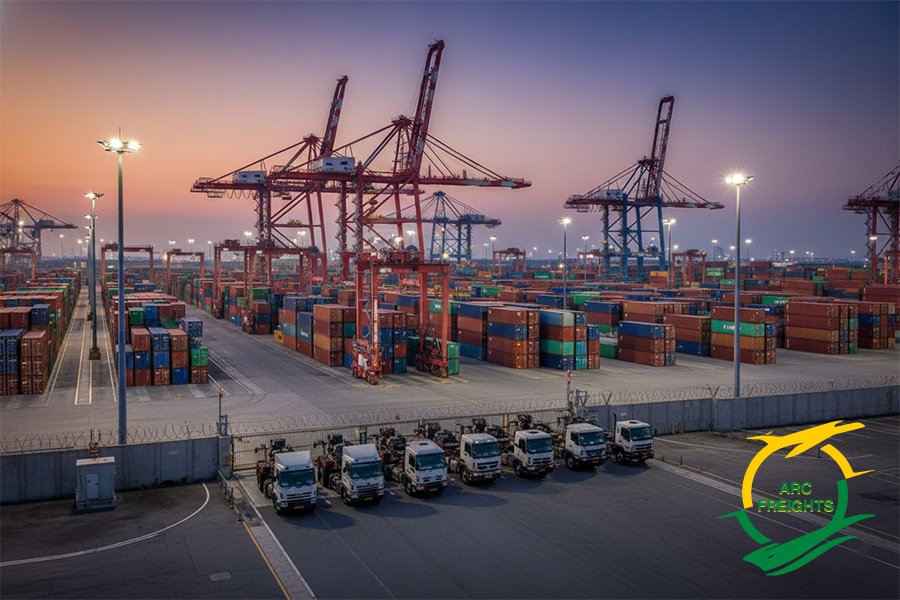
In the current Australian shipping landscape, the price of a sea freight booking is only one half of the equation. A more localized set of expenses—known as landside charges—is increasingly dictating the billing for importers and exporters alike. As per the ACCC’s Container Stevedoring Monitoring Report 2024-25, these fees now constitute nearly 50% of revenue generated by the local stevedoring industry.
This article details what these costs are to help Australian businesses better forecast and plan their supply chains.
Landside Charges
Landside charges refer to the fees levied by terminal operators (stevedores) for the movement and handling of cargo within the port gates. Unlike sea freight, which is subject to international market fluctuations, landside charges are domestic, fixed, and largely non-negotiable.
These costs generally fall into three categories:
- Terminal Access Charges (TACs)
- Often listed as infrastructure levies, these are fees charged by the port for a truck to deliver a container to the terminal.
- Vehicle Booking System (VBS) Fees
- These are charges for the time slots required to coordinate truck movements within the terminal.
- Ancillary Charges
- For many of Australia’s core exports—such as temperature-controlled premium produce or heavy machinery for the mining sector—additional landside fees apply for power (reefer points) or specialized lifting equipment (Out of Gauge Shipping).
These unavoidable costs land first on trucking companies, who then pass them on to importers and exporters, who have no real way to avoid or negotiate them.
Current Situation
The rate increases aren’t sudden. The stevedoring industry has been significantly increasing terminal access charges since 2017. As reported by ACCC, this has led to the collection of over $3 billion in revenue.
This observation comes in spite of significant spare capacity in ports and stevedoring costs and productivity remaining relatively stable in recent years. As ACCC Commissioner Anna Brakey explains, one would typically expect to see “excess terminal capacity placing downward pressure on the stevedores’ prices”.
The report concludes that a Government policy or regulatory response is likely required to address apparent market failures and improve Australia’s container freight supply chain to the benefit of households and businesses.
Margin Erosion
When landside fees increase—such as the 19.4% jump noted in recent years—businesses that have not factored these into their landed cost calculations will see their profit margins shrink.
Budgeting Uncertainty
Unlike shipping rates, which are often quoted months in advance, landside levies can be adjusted by terminals with relatively short notice periods.
Impact on International Competitiveness
In the highly competitive ASEAN markets—including Singapore, Vietnam, and Indonesia—Australian products often compete with goods from Europe, the Americas, and intra-regional neighbors. In these markets, the “landed cost” (the total cost of the product upon arrival) is the deciding factor for buyers.
Further Reading: A Comprehensive Guide To Import And Export In Singapore
Further Reading: A Comprehensive Guide To Import And Export In Indonesia
Further Reading: A Comprehensive Guide To Import And Export In Vietnam
High domestic landside costs act as a friction point. If it costs more to move a container through a terminal in Melbourne or Sydney than it does in a global hub like Singapore, the Australian product starts at a price disadvantage. When domestic port fees rise while international competitors’ costs remain stable, Australian wheat, meat, wine, and manufactured goods become harder to sell overseas.
Further Reading: Introduction To Exporting Wine
The ACCC report suggests that because these landside fees are applied uniformly across major Australian terminals, exporters cannot “shop around” to avoid them, making them a fixed burden on the Australian export economy.
Freight Forwarding
While landside charges are fixed by terminal operators, the role of a freight forwarder in this environment shifts from “price negotiator” to “strategic navigator.” Because these fees are non-negotiable and “unavoidable,” the value of a logistics partner lies in operational efficiency and transparency.
A sophisticated forwarding strategy focuses on three areas to mitigate the impact of these rising costs:
- Lump Sum Advantage
- By utilizing “All-In” or Lump Sum pricing, the freight forwarder can act as a shock absorber for the client. The forwarder provides a fixed rate that includes the myriad of landside fees (TACs, VBS, and Ancillaries). This transfers the risk of sudden, “short-notice” price spikes from the exporter to the logistics provider.
- Operational Precision
- Since Vehicle Booking System (VBS) fees and terminal access charges are tied to specific time slots, any delay in the “last mile” transport can result in double-handling fees or missed-slot penalties. Efficient forwarders coordinate the synchronization between the farm or factory gate and the terminal gate to ensure that these landside costs are paid only once.
- ASEAN Hub Strategy
- For exporters shipping to high-efficiency ports like Singapore, forwarders can help balance high Australian departure costs by optimizing the arrival logistics. By understanding the cost structures of both the origin and destination ports, businesses can better calculate the true “landed cost” and adjust their regional pricing strategies accordingly.
Conclusion
Landside charges are a permanent fixture of international shipping. While unavoidable, one can manage their impact. Fortunately, businesses do not have to navigate this alone. Professional logistics management helps turn these port hurdles into manageable expenses.
Arc Freights is Australia’s leading Freight Forwarder offering QUALITY & RELIABLE logistics services in more than 140 countries. Having plied our expertise in ASEAN for nearly two decades, we are the trusted partner for logistics between Australia and Brunei, Cambodia, Indonesia, Laos, Malaysia, Myanmar, Philippines, Singapore, Thailand, and Vietnam. With expert knowledge, advanced technology, and a commitment to reliability, we provide seamless logistics management, including door-to-door sea freight services, that helps you focus on what matters most—growing your business.